In the fast-paced modern kitchen, an electric kettle has become an indispensable appliance, effortlessly delivering boiling water for your morning coffee, a comforting cup of tea, or instant meal preparations. Yet, a fundamental question often arises when choosing a new model: “What’s the deal with wattage?” Specifically, many wonder if a 1500W electric kettle genuinely boils water faster than its 1000W counterpart, and what this difference means for their daily routine and energy bills. Understanding wattage is key to making an informed decision that perfectly aligns with your needs for speed, efficiency, and budget.
Understanding Electric Kettle Wattage
Wattage, measured in watts (W), is essentially the rate at which an electric kettle consumes electrical energy and converts it into heat. It’s a direct indicator of the appliance’s power output. Think of it like a car’s horsepower: higher horsepower generally means faster acceleration. For an electric kettle, higher wattage translates directly to a quicker heating process. The fundamental electrical principle states that power (Watts) equals Voltage (V) multiplied by Amperage (A). This means that a kettle’s wattage is determined by the electrical current it draws and the voltage supplied by your outlet.
History and Evolution of Electric Kettles
The journey of the electric kettle from its rudimentary beginnings to the sophisticated appliances we use today is marked by continuous innovation, primarily focused on speed and efficiency. Early electric kettles were simple heating elements within a metal pot. Over time, advancements in heating element technology, insulation, and automatic safety features transformed them into the rapid-boil devices we recognize. A significant part of this evolution has been the increase in wattage, driven by consumer demand for faster boiling times, leading to the prevalent 1500W to 3000W models commonly found in kitchens worldwide.
The Speed Factor: 1500W vs. 1000W
When directly comparing a 1500W electric kettle to a 1000W model, the answer to “Is 1500W faster?” is an unequivocal yes. The higher wattage means the heating element can generate more heat in a shorter period, transferring that energy to the water more rapidly. This difference in speed can be quite noticeable in daily use.
Consider a typical scenario of boiling one liter of water. A 1500W kettle will generally bring that water to a rolling boil in approximately 3 to 5 minutes. In contrast, a 1000W kettle will take a noticeably longer time, often closer to 5 to 7 minutes or even more, to achieve the same result. For those busy mornings or when you need hot water instantly, this difference of a couple of minutes can be significant.
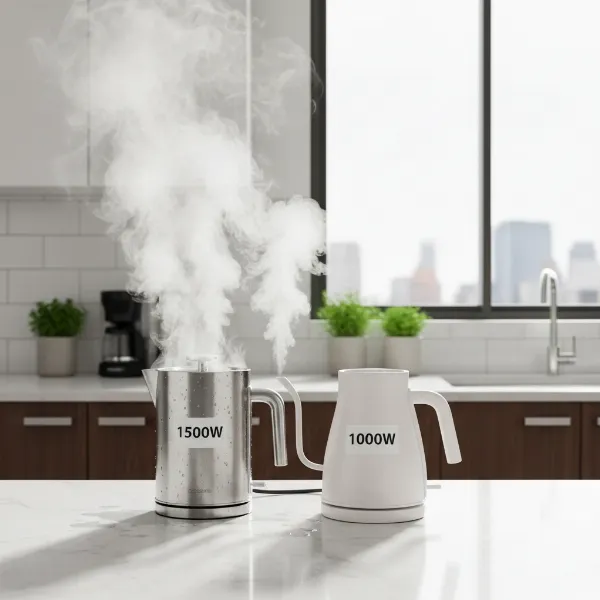 Side-by-side comparison of 1500W and 1000W electric kettles, with steam illustrating faster boiling for the higher wattage
Energy Consumption: The Nuance of Efficiency
This is where the wattage discussion becomes more nuanced and often misunderstood. While a 1500W kettle draws more power per minute than a 1000W kettle, it doesn’t necessarily mean it uses more total electricity to boil the same amount of water. In fact, a higher-wattage kettle can sometimes be more energy-efficient for a single boil.
The key lies in the total duration of operation. A 1500W kettle boils water faster, meaning it operates for a shorter period. During the boiling process, some heat inevitably escapes into the surrounding environment. By reducing the boiling time, a higher-wattage kettle minimizes the window for this heat loss to occur, potentially resulting in similar or even slightly less overall energy (kilowatt-hours, kWh) consumed to heat the identical volume of water.
For example, boiling one liter of water:
- A 1500W kettle might take 5 minutes and consume approximately 0.125 kWh.
- A 1000W kettle might take 7 minutes and consume approximately 0.117 kWh.
While the 1000W shows slightly less here, other data suggests figures can be very close, with some 1500W to 2500W models consuming roughly the same total kWh for the same task. Some sources may suggest lower wattage kettles use “20% less energy.” This typically refers to the instantaneous power draw, not the total energy required to complete the task of boiling a specific volume of water from a specific starting temperature.
Factors Beyond Wattage Affecting Kettle Performance
While wattage is a primary driver of boiling speed, several other factors also play a crucial role in how efficiently and quickly your electric kettle operates:
- Water Volume and Initial Temperature: The more water you need to boil, and the colder its starting temperature, the longer it will take, regardless of wattage.
- Kettle Material and Insulation: Kettles made with good insulation (e.g., double-walled stainless steel) minimize heat loss, helping water boil faster and stay hot longer. Glass or thin plastic kettles may lose heat more quickly.
- Heating Element Efficiency: The quality and design of the heating element itself can influence how effectively electrical energy is converted into thermal energy.
- Voltage in Your Region: The electrical voltage supplied to your home (e.g., 110-120V in North America vs. 220-240V in Europe and many other regions) significantly impacts a kettle’s actual power output. A kettle rated at 1500W in a 220V region will perform differently than a 1500W kettle in a 110V region due to amperage limitations in household circuits.
- Altitude: At higher altitudes, water boils at a lower temperature, which can paradoxically make it seem to boil faster, but it also means less energy is required to reach that lower boiling point.
Choosing the Right Electric Kettle Wattage for Your Needs
Selecting the ideal wattage for your electric kettle depends heavily on your lifestyle and priorities.
- Prioritize Speed (1500W and Above): If you often find yourself rushing in the mornings, need multiple servings of hot beverages quickly, or frequently boil water for cooking, a kettle with 1500W or higher (up to 3000W, common in 220-240V regions) is your best bet. This ensures rapid boiling, saving you precious time.
- Prioritize Portability or Limited Power (1000W or Less): For travel, dorm rooms, or areas with older wiring or lower amperage limits on circuits, a lower-wattage kettle (e.g., 800-1000W) might be a more practical and safer choice. While slower, it reduces the risk of overloading circuits.
- Consider Kettle Capacity: A larger capacity kettle will generally benefit from a higher wattage to heat larger volumes efficiently. For small, personal-use kettles (e.g., 0.5-1 liter), a lower wattage might be sufficient if speed isn’t a critical concern.
- Additional Features: Modern kettles offer variable temperature control, keep-warm functions, and auto shut-off, enhancing user experience and efficiency, irrespective of wattage.
Expert Insights on Electric Kettle Wattage
Many experts in kitchen appliances suggest that for most households, a kettle ranging from 1800 to 2000 watts (in a 120V system, or 2500-3000W in a 220V system) strikes an excellent balance. This range provides notably faster boiling times without typically leading to significantly higher energy bills for routine use, thanks to the reduced operational time. The consensus is that quicker boiling minimizes heat dissipation, optimizing the energy used for the task at hand.
“For optimal performance in a standard kitchen, aiming for an electric kettle with at least 1500 watts, and ideally closer to 1800-2000 watts, offers the best balance of speed and overall energy efficiency for typical household use.”
Comparative Table: Electric Kettle Wattage and Characteristics
Here’s a general overview of characteristics across different wattage ranges, assuming standard operation and a 1.7-liter capacity kettle in a 120V region where applicable:
| Wattage Range | Boiling Speed (1L water) | Typical Energy Usage (per boil) | Ideal Use Case | Pros | Cons |
|---|---|---|---|---|---|
| 800-1000W | 5-7+ minutes | ~0.11-0.12 kWh | Small households, travel, energy-conscious | Lower initial power draw | Slower boiling times |
| 1200-1500W | 3-5 minutes | ~0.12-0.13 kWh | Standard households, daily use | Good balance of speed and power | Might feel slow for very impatient users |
| 1800-2000W+ | 2-3.5 minutes | ~0.12-0.14 kWh | Busy households, entertaining, rapid boiling | Very fast boiling, minimal heat loss during boil | Higher peak power draw, check circuit capacity |
Note: Boiling times and energy consumption are approximate and can vary based on specific kettle design, water volume, and starting temperature.
Tips for Using and Maintaining Your Electric Kettle
To maximize your electric kettle’s efficiency and longevity, follow these practical tips:
- Boil Only What You Need: The single biggest factor affecting energy consumption is the volume of water. Filling the kettle with only the amount you intend to use saves both time and electricity.
- Regular Descaling: Mineral deposits (limescale) can accumulate on the heating element, reducing its efficiency and slowing down boiling. Descale your kettle regularly using vinegar or a specialized descaling product.
- Unplug When Not in Use: While minimal, some kettles draw a small amount of “standby power” even when switched off but plugged in. Unplugging it completely eliminates this phantom load.
- Choose the Right Size: If you consistently boil small amounts, a smaller kettle can be more efficient than a large one that heats a greater surface area.
- Keep the Lid Closed: Ensure the lid is properly closed during boiling to prevent heat from escaping and to ensure the automatic shut-off mechanism functions correctly.
Common Electric Kettle Issues and Troubleshooting
Even with robust designs, electric kettles can occasionally encounter problems.
- Kettle Not Heating: First, check if it’s properly plugged into a functional outlet. Ensure the kettle is securely seated on its base. If the issue persists, the heating element might be faulty, or a safety mechanism may have tripped (e.g., dry-boil protection).
- Slow Boiling: If your kettle suddenly takes longer to boil, check for limescale buildup. A thick layer of scale can significantly impede heat transfer. Also, ensure you’re not trying to boil an excessive amount of water for your kettle’s wattage.
- Leaks: Leaks are typically a sign of physical damage to the kettle body or seals. Unfortunately, many leaks are difficult or unsafe to repair and usually warrant replacing the kettle.
- Unusual Odors/Taste: New kettles can sometimes emit a plastic smell initially. Boil and discard water a few times. For persistent odors or metallic tastes, thorough cleaning and descaling might help. If it persists, it could indicate a manufacturing defect.
Where to Buy Electric Kettles
Electric kettles are widely available, both in physical stores and online.
- Electronics and Appliance Stores: Major retailers specializing in home appliances typically offer a broad selection of electric kettles across various brands and wattages. This allows for hands-on inspection and immediate purchase.
- Online Retailers: E-commerce platforms provide an extensive range of models, often with competitive pricing and user reviews that can be invaluable for making a choice. Remember to check return policies and warranty information when purchasing online.
- Department Stores and Home Goods Retailers: These stores often carry popular brands and designs, blending functionality with aesthetic appeal for your kitchen.
When purchasing, always verify the kettle’s wattage, capacity, material, and safety features. Reading recent customer reviews can offer insights into real-world performance and durability.
Conclusion
In the debate between a 1500W and a 1000W electric kettle, the 1500W model undeniably wins in terms of boiling speed. It brings water to temperature faster, saving you precious moments in your day. While it draws more instantaneous power, the total energy consumed for boiling the same amount of water is often comparable, and sometimes even slightly less, due to reduced heat loss over a shorter operational period. Ultimately, the “best” wattage for your electric kettle boils down to your personal priorities: whether you value rapid boiling above all else, or if a slightly slower but potentially more circuit-friendly option is preferred. By understanding how wattage works and considering other critical factors, you can confidently choose the electric kettle that perfectly fits your kitchen and lifestyle.
What wattage does your current kettle have, and how has it impacted your daily routine?
Frequently Asked Questions
Is 1500W enough for an electric kettle?
Table is empty.Yes, 1500W is generally considered an excellent wattage for an electric kettle, offering a good balance of rapid boiling speed and practical energy use for most household needs. It can typically boil a liter of water in about 3 to 5 minutes.
Do higher wattage kettles use more electricity overall?
Not necessarily for a single boiling task. While a higher wattage kettle draws more power at any given moment, it boils water faster, thereby operating for a shorter duration. This can result in similar or even slightly lower overall energy consumption (kWh) compared to lower wattage models, as less heat is lost to the environment.
How long does a 1500W kettle take to boil water?
A 1500W electric kettle typically takes around 3 to 5 minutes to boil 1 liter of water, depending on the starting temperature of the water, the kettle’s efficiency, and environmental factors.
What is the ideal wattage for an electric kettle?
For optimal speed and efficiency in most home settings, an Electric Kettle with a wattage between 1500W and 2000W (in 110-120V regions) or 2500W-3000W (in 220-240V regions) is often considered ideal. This range offers quick boiling times while being practical for most household electrical circuits.
Does water volume affect boiling time in an electric kettle?
Absolutely. The amount of water in the kettle is one of the most significant factors affecting boiling time. More water requires more energy to reach boiling point, regardless of the kettle’s wattage, thus increasing the time it takes to boil.